A Pair of Diamonds
At the Quantum World Congress, Element Six shows me two diamonds, one that builds a business, another that measures biology
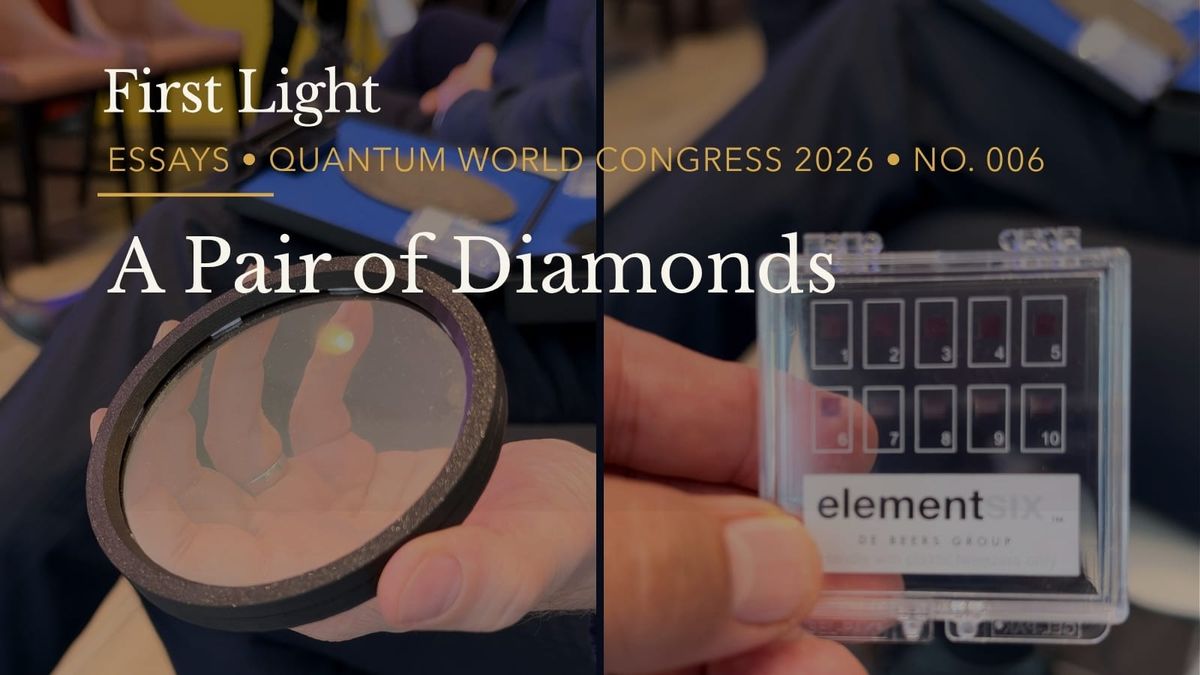
Dr. Matthew Markham is a principal scientist at a company called Element Six. At the Quantum World Congress, held September 23 to 25, 2026 at The Hotel at the University of Maryland, I introduce myself as someone interested in NV quantum sensing. (NV stands for nitrogen vacancy in a diamond material, and quantum sensing is an application area that uses quantum effects to make extremely sensitive measurements.) He shows me the NV diamond sensors, which look like little rectangles of diamond only 3 mm across, in a De Beers Group box. And then he pulls out a 300 mm disc, currently used in advanced chip manufacturing. That entire disc is a synthetic diamond. It is fascinating.
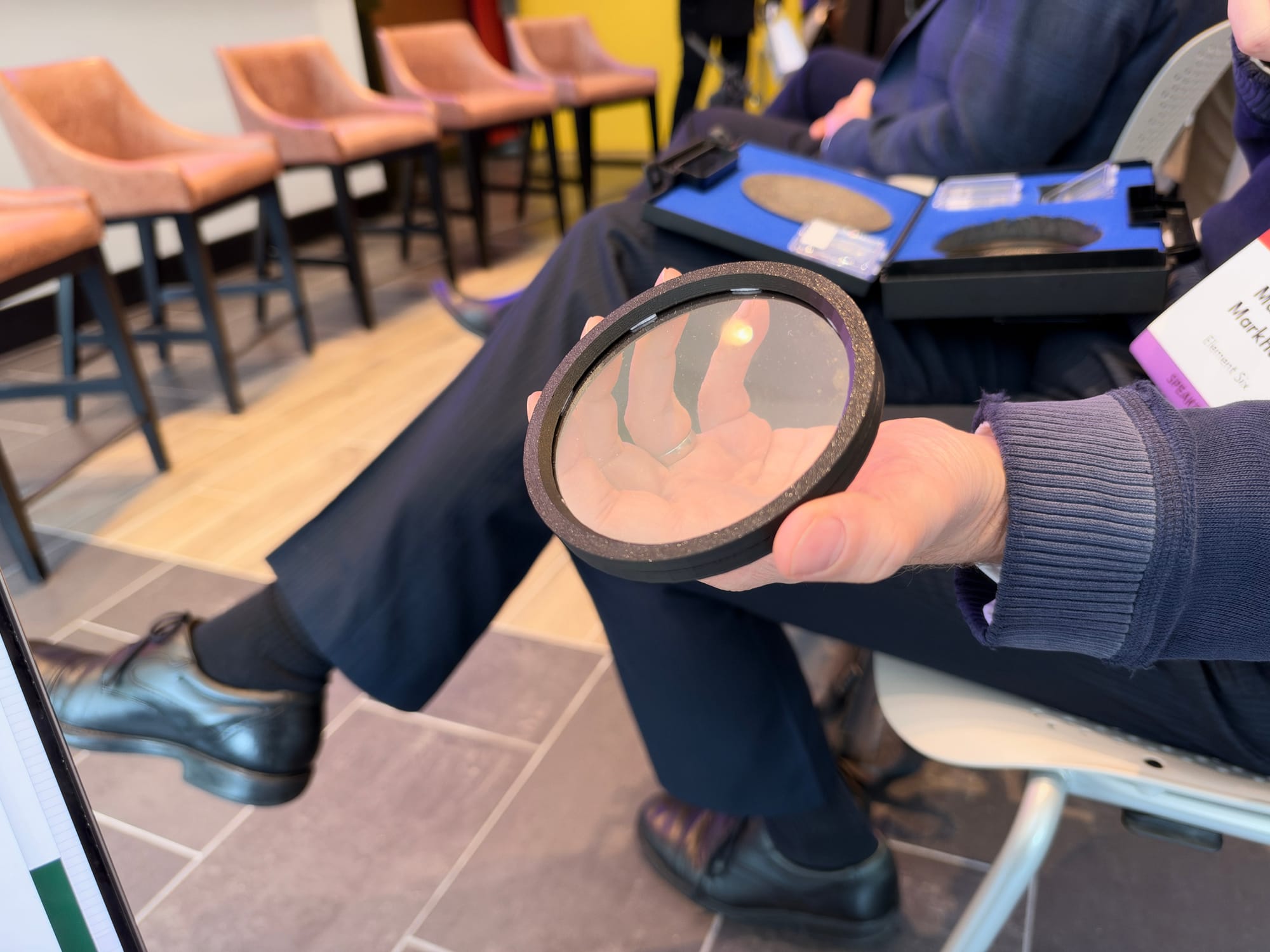
Dr. Markham had a few other types of quantum diamonds to show me as well. The nitrogen vacancy one was pink-purple, another had silicon instead of nitrogen, and a third had a lower concentration of nitrogen with slightly different properties.
The large 300 mm disc is the commercial, proven product that brings in revenue from their silicon foundry customers. The small 3 mm chips are a speculative, purposely impure, product that is finding its way into new markets and customers. The large disc is valuable because of its purity and unique features; the small chips are valuable because of their specific impurity, and contain unique features whose value is being explored.
In my prior post (“A Newcomer’s Map of Quantum”) I described the BioHealth Capital Region forum’s panel session, which led me to the Quantum World Congress a week later. This post is about a few things I discovered there, namely quantum sensors, potential applications of these sensors, and which applications may be the nearest to market.
What Is an NV Quantum Sensor?
Dr. Wolfgang Losert, a University of Maryland physics professor who studies the dynamics of living systems, made a useful point at the BioHealth panel: if anyone has had an MRI scan, they have already been measured by a quantum sensor. MRI reads the spins of hydrogen nuclei of water molecules inside the body, as a strong magnet lines them up and they relax back throwing off a signal. The diamond chips in Dr. Markham's box are a related idea at a much smaller scale: they use quantum effects to sense what is happening in close proximity.
N stands for nitrogen, V for vacancy, and an NV center is a single nitrogen atom sitting next to a hole, a missing carbon atom, in the diamond's carbon lattice. Impurities in natural diamonds create colored diamonds; nitrogen on its own turns a diamond yellow or brown. The NV centers themselves are what give quantum diamonds their pink-to-purple color, and the more NV centers packed in, the deeper the shade.
When an NV diamond is illuminated by a green laser, it fluoresces red.1 The brightness of the red is determined by the spin of an electron trapped at the defect, and that spin is sensitive to magnetic fields, to temperature, and even to the magnetic noise of free radicals nearby. The brightness of the fluorescence is a function of the environment around the diamond lattice defect, and this effect is observable at room temperature.
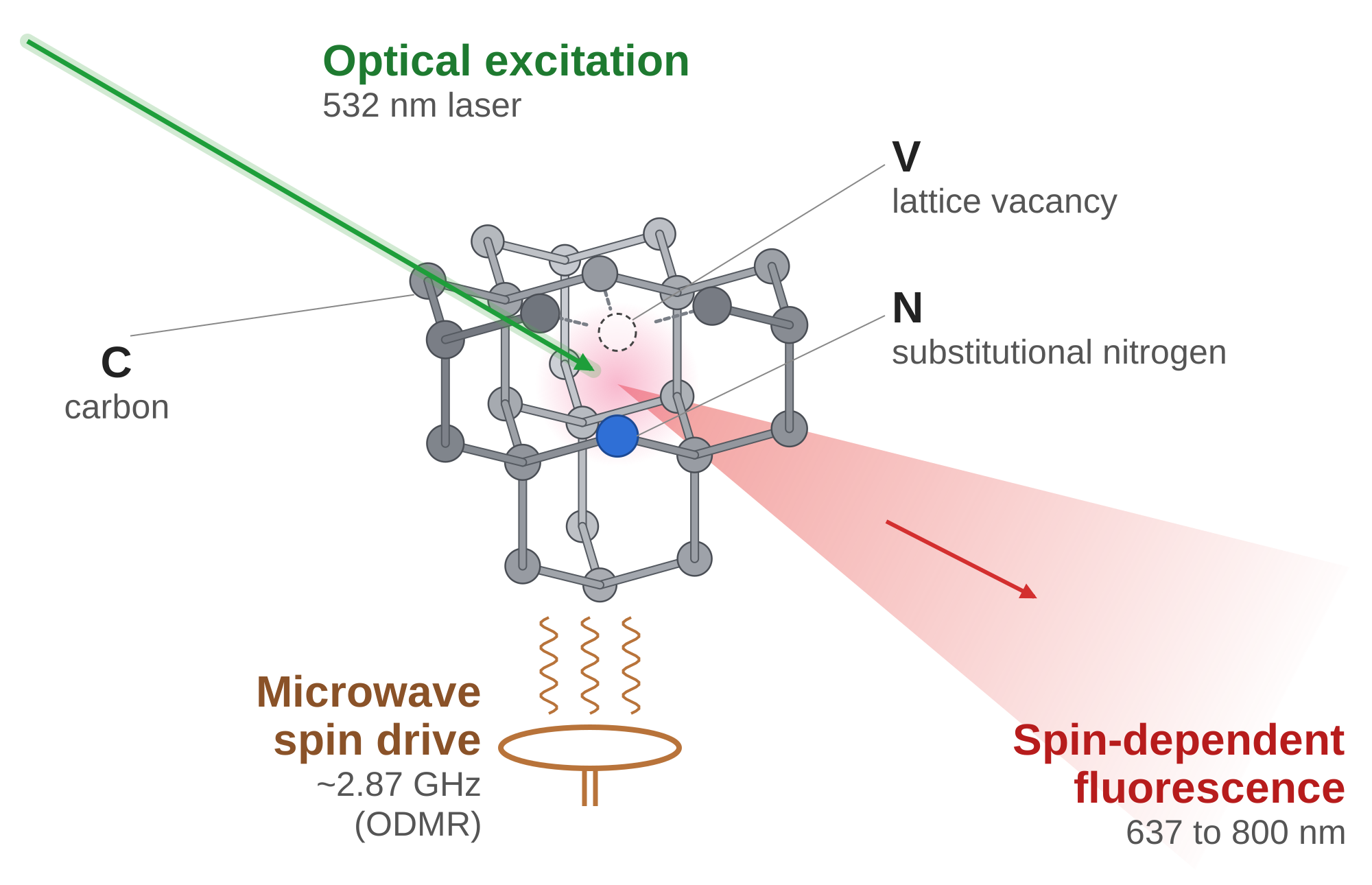
There are two main ways to read it out. The first uses microwaves. Green light sets the electron into its bright state, and microwaves at the right frequency, about 2.87 GHz, flip it into a dim state, so the red glow drops. A nearby magnetic field shifts that frequency, so sweeping the microwaves and noting where the glow dips reveals the strength of the magnetic field; a slight shift in the center frequency reveals the temperature. At about 2.87 GHz (close to the microwave frequency of both microwave ovens at 2.45 GHz and the WiFi 2.4 GHz band), the electronics needed for this microwave function are inexpensive and very familiar territory to manufacture at scale.
The second method, and the one most relevant to free radicals, often needs no microwaves at all. The green laser resets the electron to its bright state, and then you monitor how quickly the red glow fades as the spin drifts back on its own. Slower fading means less perturbation; faster fading means more magnetic noise nearby, related to the analyte being measured (reactive oxygen species, as one example). Physicists call this relaxometry.
Being able to interrogate living systems with a laser and inexpensive electronics, to measure what has been difficult or not possible before, is what this technology has to offer.
Why NV Quantum Sensors Have Potential
The first application is magnetic sensing. An NV sensor can measure very small magnetic fields. That makes magnetometry of the body's own electrical activity feasible: magnetoencephalography (MEG) for the brain, and magnetocardiography for the heart. (Today's wearable MEG systems use a different quantum sensor, optically pumped magnetometers based on atomic vapor, which already offer non-invasive brain electrophysiology measurements.2 Element Six positions NV diamond as a compact, room temperature option for this type of medical sensing.)
Another application is temperature measurement, non-invasively and from inside a cell. While there are several other approaches (small-molecule fluorescent dyes or genetically encoded sensors), their readings can shift for many reasons, such as pH or dye concentration. A diamond NV sensor reads temperature as a shift in frequency rather than brightness, so it is affected by only a few parameters.3
A third application is measuring the presence of free radicals, such as reactive oxygen species.4 I believe this one to be commercially attractive. ROS is an ideal analyte for indicating cell stress, from whatever source. In a drug discovery paradigm, it would be cell toxicology in the ADME-TOX context. (Getting away from animal models has been a top priority at the NIH and the FDA.) As a cancer diagnostic, relative ROS levels might one day help identify precancerous lesions, though that remains a research question. Interestingly, the same nanodiamond can report temperature alongside free radicals, giving two readouts of cell stress at once. At the BioHealth panel, Dr. Losert described the real opportunity as measuring things biology has never been able to measure before. He repeated this statement in his presentation at Quantum World Congress.
The implementation of this technology could be as a probe inside cells. Nanodiamonds containing NV centers can be made just tens of nanometers across, hundreds of times smaller than a typical cell, and are readily absorbed by individual cells. Another implementation is to have the NV diamond as a flat surface for the cells or sample to be spread out upon, much like a microscope slide.
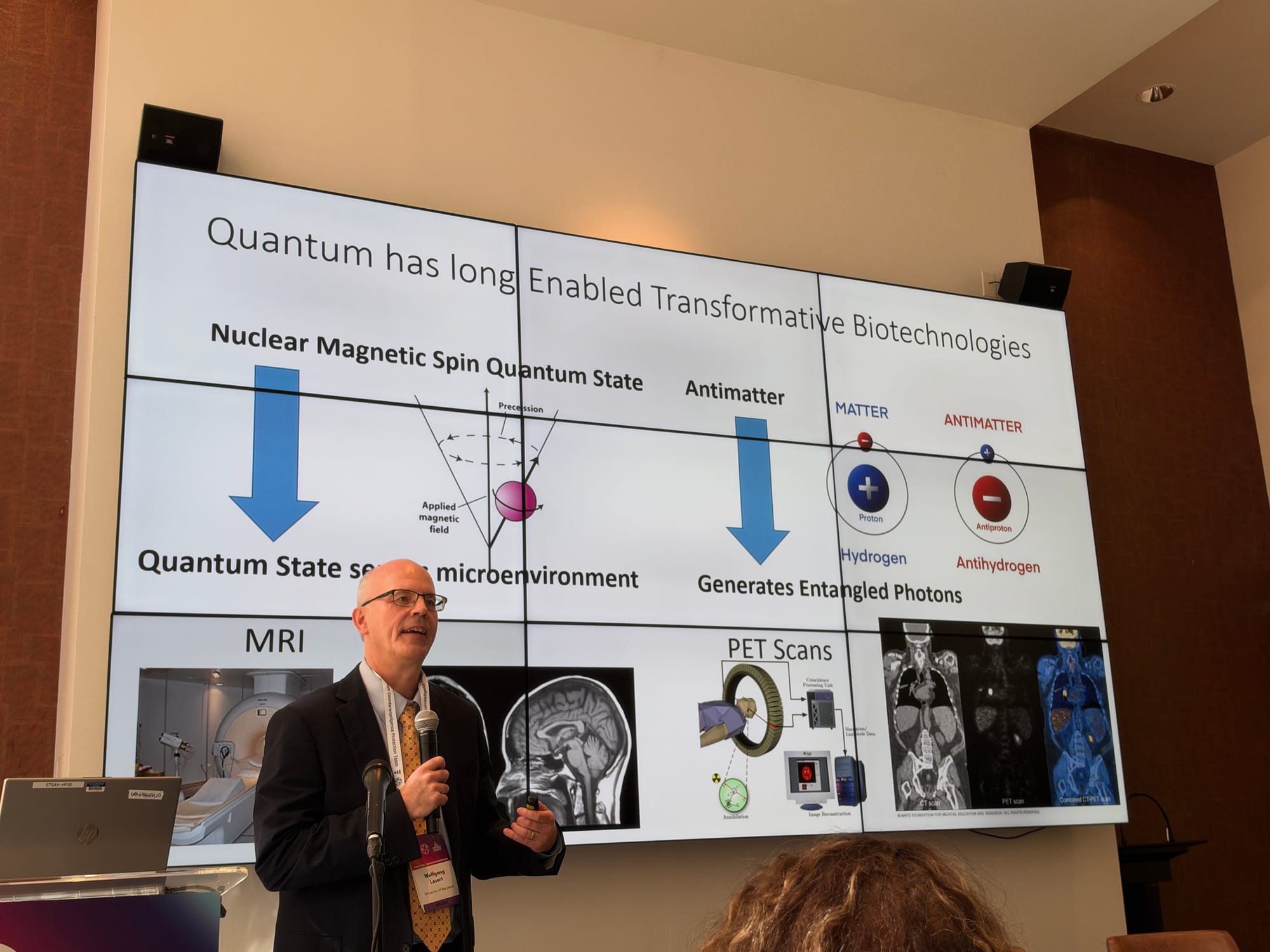
In his talk at the Quantum World Congress, Dr. Losert noted that nuclear physics already underpins medical imaging with MRI and PET scanners. He organized a Quantum Biotechnology Workshop at the University of Maryland last spring, and will organize another one in 2027. One conclusion he shared is that disease is currently diagnosed too late, and there is a need for direct, in-tissue quantum sensing. It could be reactive oxygen species, it could be membrane stiffness, it could be interrogating metabolism directly, or another physical characteristic. He added that measuring the chronic inflammation of aging, also known as "inflammaging," must be done reliably, in vivo, on clinically relevant timescales.
One Material with Several Markets
It was interesting to hear Dr. Markham tell me some of the backstory of Element Six, part of the De Beers Group, whose industrial diamond business formally began with diamonds considered unsellable as jewelry, back in 1946. Those flawed stones (called "bort") went into machine tools, and now, 80 years later, Element Six grows synthetic diamonds with the flaws placed on purpose. (2026 is Element Six's 80th anniversary.)
Element Six has an industrial product (the 300 mm diamond disc) and a speculative one (NV quantum diamond for biosensing) to sell to tool developers.
The microchip world already knows that NV sensing can pay off. EuQlid, the Q-Cat spinout Amanda Stein mentioned at the BioHealth panel, uses NV quantum sensors for semiconductor manufacturing. Its instruments map electrical current inside microchips in a non-destructive way. Founded in 2022 in College Park, EuQlid raised a $3M seed round in November 2025, and reported $1.5M in early customer revenue.
Its operating principle is detection of the magnetic fields that electrical current creates, and with nano-ampere sensitivity they call their product Qu-MRI (reminiscent of MRI scanners). For microchips that are increasingly 3-dimensional, an X-ray shows whether the wiring is there, while EuQlid shows whether current is actually flowing through it. EuQlid is measuring function, and not structure. The analogy to biology is clear.
In semiconductor manufacturing, measuring function for microprocessor manufacturing yield is a critical metric, and a single undetected defect can affect an entire batch of very expensive wafers. The large market for semiconductor manufacturing inspection tooling is on the order of $10B, dominated by one manufacturer, KLA. The subsegment for finding electrical defects is plausibly in the hundreds of millions of dollars (my own estimate), still a substantial market and one growing quickly, due to the increasing complexity of chips made for the explosion in AI datacenters.
IonQ's Matt Keesan, from the BioHealth panel I described in the prior post, made a related point: the same sensor can serve several markets, and whether it becomes a billion-dollar business or a million-dollar one depends on the problem you pick and the story you tell. His point is simple, which is the need to pick a large problem and have an effective solution to it. EuQlid's "$10 billion" headline and its real niche illustrate exactly that.
My Own Opinion
It has been a remarkable two weeks to learn about the edges of a nascent field. De Beers has a large business in industrial diamonds, and a speculative technology is emerging from it with NV quantum sensors looking for a life science application. The life sciences potential is tantalizing, but stays out of reach because the practical application remains a research project.
In my own experience at life science major companies, there were plenty of science experiments that failed. Lots of technical solutions to solve a particular problem, and some made it to market, others did not. In 2002, for example, quantum dot technology was hailed (in some quarters) as the next great replacement for fluorescent dyes. Now almost a quarter century later quantum dots appear in the world of televisions, and are now even re-appearing at Quantum World Congress as the functional qubit itself (sponsors such as Quantum Motion in the UK and SemiQon from Finland are taking this approach). Invitrogen did purchase Quantum Dot Corporation in 2005, and Qdots are still sold today under Thermo Fisher Scientific as streptavidin conjugates, but are still a niche.
This is one example (of many) where a fundamentally superior product could lose out for a number of reasons. For cell labeling, substitutes and alternatives for the quantum dot (for example BD's 2012 acquisition of Sirigen, maker of the Brilliant Violet dyes) keep the quantum dot technology as a specialty cell label.
If I were exploring applications I would do what Element Six is doing. Travel to places where unmet need intersects with tool vendors who are scouting new technology for life science applications. Perhaps a presence at large genetics and cancer conferences where emerging technology is common as a scientific poster. The American Society of Human Genetics, the American Association for Cancer Research and perhaps the Society for Neuroscience are so large and well-attended, that a well-purposed proof-of-concept poster could attract the right target audience.
This assumes they have solid relationships with key researchers working on life science applications. The appetite for new technology is certainly there.
On one of his slides, Dr. Markham counted more than 90 companies building on diamond sensors, and his healthcare slide showed two: QDTI of Somerville, MA, and the multinational company Bosch. I expect that slide to grow over the coming quarters.
For the next post, I'll trace a few companies' history and their pivot away from biology.
Notes and References
1. The green light is typically 532 nm, an ordinary green laser's wavelength and widely available, although the NV center absorbs across a range from about 450 to 640 nm. The red emission has a sharp line at 637 nm and a broad band extending into the near-infrared; instruments typically filter out light shorter than about 650 nm and collect the rest.
2. Hill R.M., Brookes M.J. et al. NeuroImage 2020, "Multichannel whole-head OPM-MEG: Helmet design and a comparison with a conventional system." doi:10.1016/j.neuroimage.2020.116995 | PubMed
3. Kucsko G. et al. Nature 2013, "Nanometre-scale thermometry in a living cell." doi:10.1038/nature12373 | PubMed
4. Nie L., Schirhagl R. et al. Nano Letters 2022, "Quantum Sensing of Free Radicals in Primary Human Dendritic Cells." doi:10.1021/acs.nanolett.1c03021 | PubMed