A Newcomer’s Map of Quantum

At the recent BioHealth Capital Region Forum, just before a panel on quantum technology, host Rich Bendis asked the audience who was not familiar with IonQ. I was one of a handful of people who raised a hand. The last time I looked into quantum computing as a field was perhaps a decade ago, reading about D-Wave and Google's investment in its technology. I was skeptical it would ever get traction given the need for these systems to operate at millikelvin temperatures, in addition to the specialized areas of problems it could solve. A vision of a need for an entire liquid helium infrastructure or other highly specialized cooling made it seem so very impractical.
The BioHealth Capital Region
The BioHealth Capital Region Forum, a local mid-Atlantic event held the week before the Quantum World Congress, is where I first caught a glimpse of how far quantum computing has come, along with a glimpse of potential life science applications. It had been perhaps 6 or 7 years since I last attended one of these BioHealth conferences, run by Rich Bendis for the Maryland / Virginia / DC biotech community. It is mainly a BIO-like opinion and narrative conference, complemented by networking opportunities with C-suite company leaders. It was rather light on content, but interesting nonetheless. I met people who were former DARPA staff, one working on a stealth startup in medical imaging, an IP lawyer who also grew up in Southern California and went to UCLA as a student, and even a business development person who works for a CDMO.
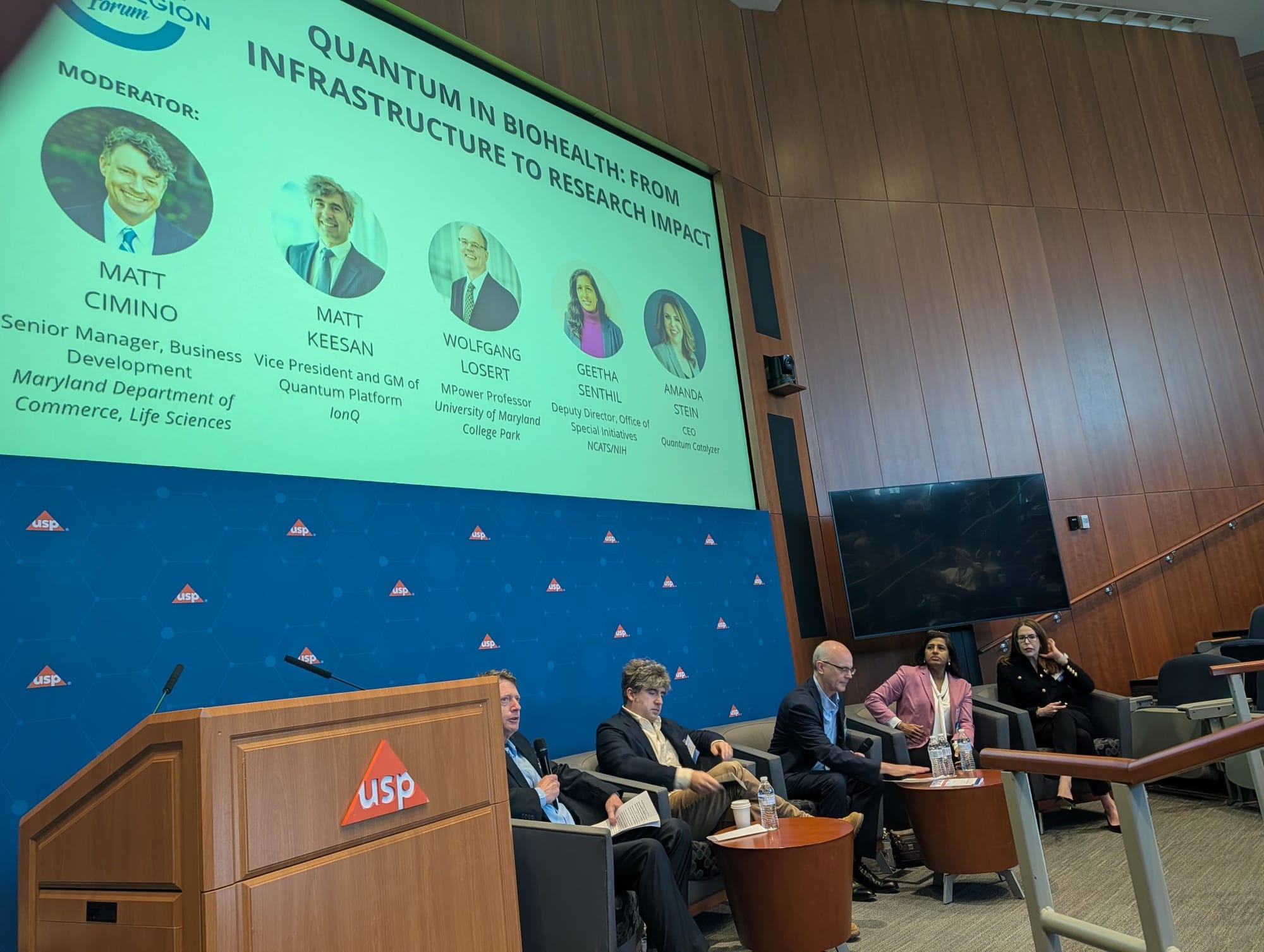
One of the panel sessions caught my attention, titled "Quantum in BioHealth: From Infrastructure to Research Impact." The panelists were Dr. Matt Keesan, VP and General Manager of Quantum Platform at IonQ; Dr. Wolfgang Losert, a University of Maryland professor of physics; Dr. Geetha Senthil, a deputy director at NCATS, the NIH's National Center for Advancing Translational Sciences; and Dr. Amanda Stein, CEO of Quantum Catalyzer (Q-Cat), a venture studio whose stated mission is to turn University of Maryland quantum sensing research into startups. Matt Cimino, from the Maryland state Department of Commerce, was moderator.
It is remarkable what 10 years can bring about. IonQ, founded in 2015 on trapped-ion research from the University of Maryland and Duke University, took a different route from superconductors. Its qubits are individual ions, held in place by electric fields inside an ultra-high vacuum chamber and cooled by lasers, so it avoids the large dilution refrigerators that superconducting machines require. They sell rack-mounted systems designed for installation into an ordinary datacenter.
IonQ went public in 2021, reported $130 million in revenue for 2025, and recently gave investor guidance to roughly $280 to $290 million for 2026 on its own (about $450 million including revenue from SkyWater, the chip foundry it acquired this summer). In September IonQ announced a 256-qubit system, which a representative told me was already deployed at customer sites, with wide rollout in 2027. (This is in contrast to the public statement of "first customer deliveries in 2027", so perhaps that statement needs to be taken with a grain of salt, however the promise of fault-tolerant quantum compute along with simultaneous scaling to 10K qubits appear to me a major announcement.)
For comparison, D-Wave announced a 512-qubit system around 2013. Qubit counts alone say little, because physical qubits have high error rates. What matters is how accurately each operation runs, and how many physical qubits it takes to build one reliable "logical" qubit. IonQ cites 99.99% accuracy for its two-qubit operations (a "two-qubit gate fidelity world record"), and the relationship between logical and physical qubits, a measure of the efficiency of a platform, was a popular plenary topic at the Quantum World Congress.
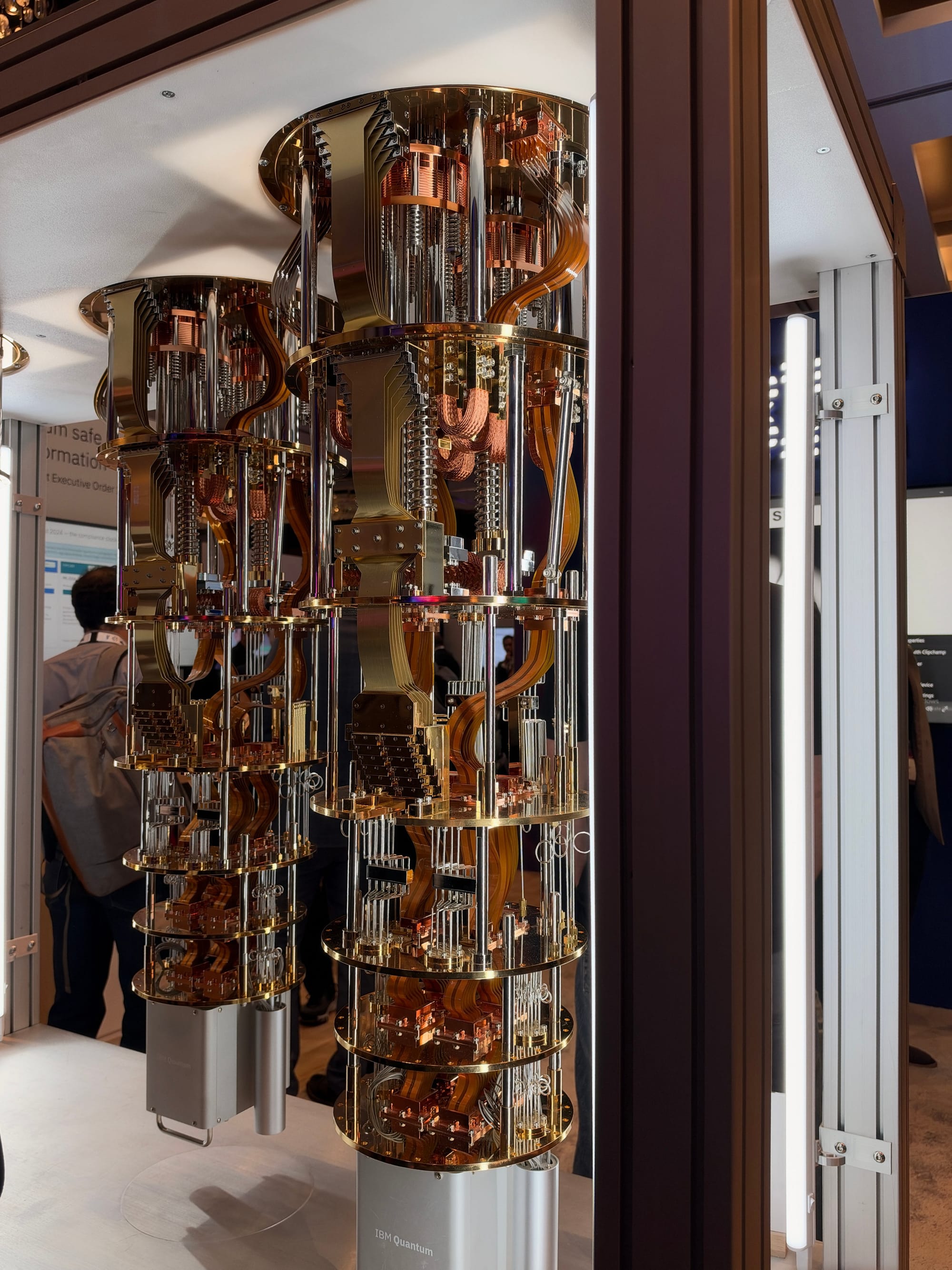
The quantum computing field has thus diverged around two major approaches: atomic (the trapped-ion as one major implementation of this approach), or solid state (superconducting as one major implementation), with photonic and other approaches also in the race. By revenue, IonQ leads the pure-play companies (IBM and Google, the technical leaders in superconducting machines, don't report quantum revenue separately), whereas D-Wave, public since 2022, reported 2025 revenue of $24.6M. The trapped-ion approach implements quantum computing for existing datacenter infrastructure. For superconducting computers, there are stories circulating where entities construct new buildings to house their superconducting quantum computing infrastructure.
One observation from IonQ's Matt Keesan was that Big Pharma is using quantum computing today to solve very specific problems, rather than waiting for "the dream" of a perfect simulation of a large protein. (In other words, modeling every atom that comprises a protein and the water molecules surrounding it from first principles.) His example was a chemistry workflow where a quantum computer handles a single step, which can speed that step up about 20-fold or remove the need for a catalyst. He mentioned AstraZeneca, and AstraZeneca and IonQ have a Quantum Computational Chemistry Centre of Excellence in Gothenburg, Sweden, focused on chemistry and pharmaceutical development.
I later spoke with a different representative from IonQ, who told me AstraZeneca is also getting value from IonQ's capability with logistics; the "traveling salesperson problem" maps neatly onto delivering temperature-sensitive pharmaceuticals worldwide.
NV quantum sensing diamonds skip the cold and the vacuum entirely: they work at room temperature and pressure.
The discussion pivoted to biosensing applications of quantum sensors.
Amanda Stein said there was no lack of ideas for where quantum sensing can go; there was just a lack of knowledge to convert these ideas into a "real product," which is what her organization aims to solve. Her College Park-based venture studio, Quantum Catalyzer (Q-Cat), was founded in 2020 by University of Maryland physicist Ronald Walsworth, to enable quantum sensing research to become commercial. She discussed EuQlid, a Q-Cat spinout that uses NV diamond sensors in semiconductor manufacturing, which I'll come back to in the next post.
Dr. Losert of the University of Maryland mentioned the Quantum World Congress being in Maryland the following week. Even though there were only a few talks on the program specific to quantum sensing for biological applications, this field is clearly ready to accelerate its commercial efforts.
Quantum World Congress 2026 and Quantum Sensors
The following week, armed with my First Light blogging credential (the organizers graciously provided me with a media pass), I had the opportunity to see some of the life science potential first-hand. This conference is more a showcase for "all things quantum" than a place for discussion and presentation of technical approaches to specific problems in the field of quantum computing.
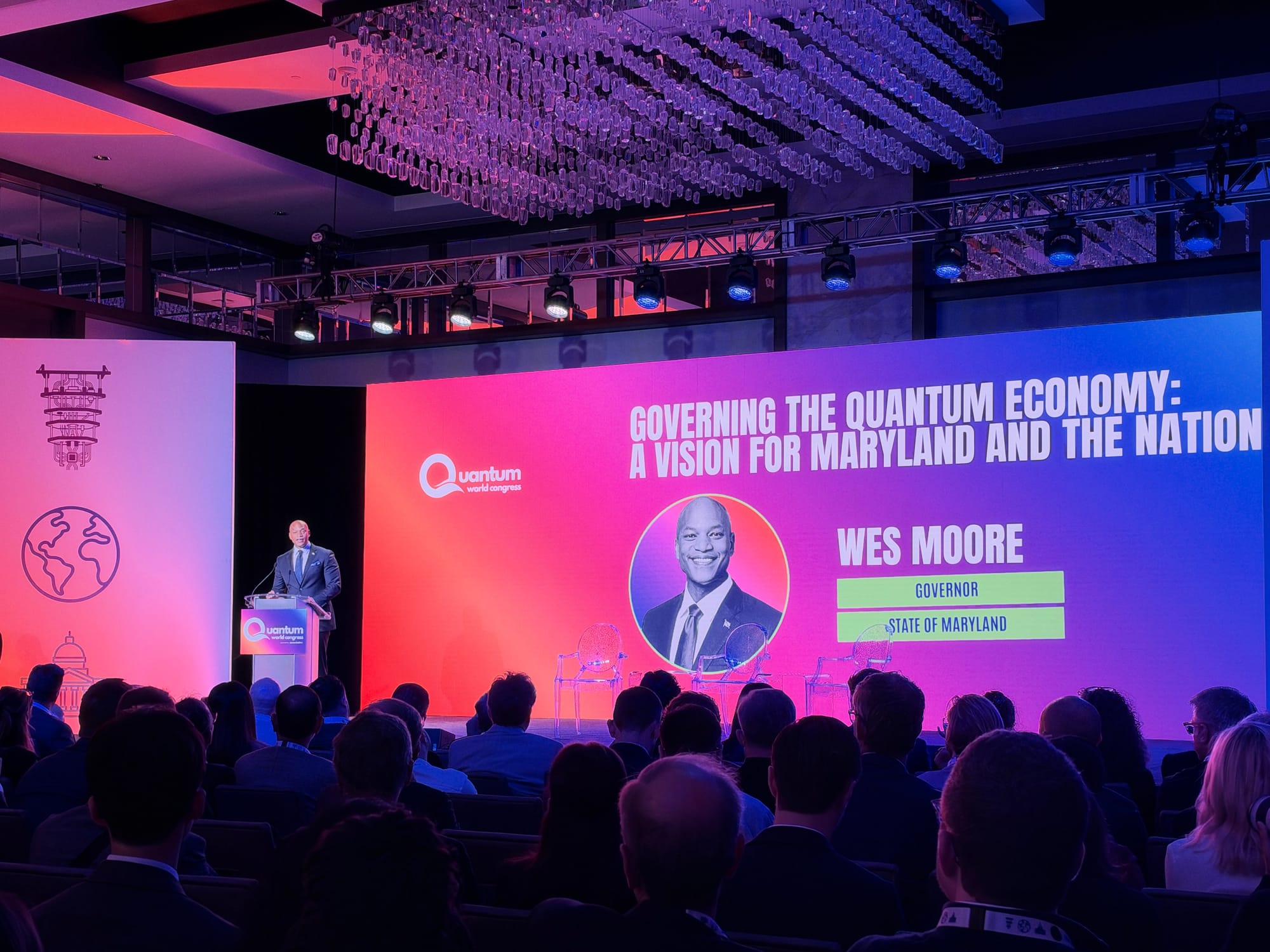
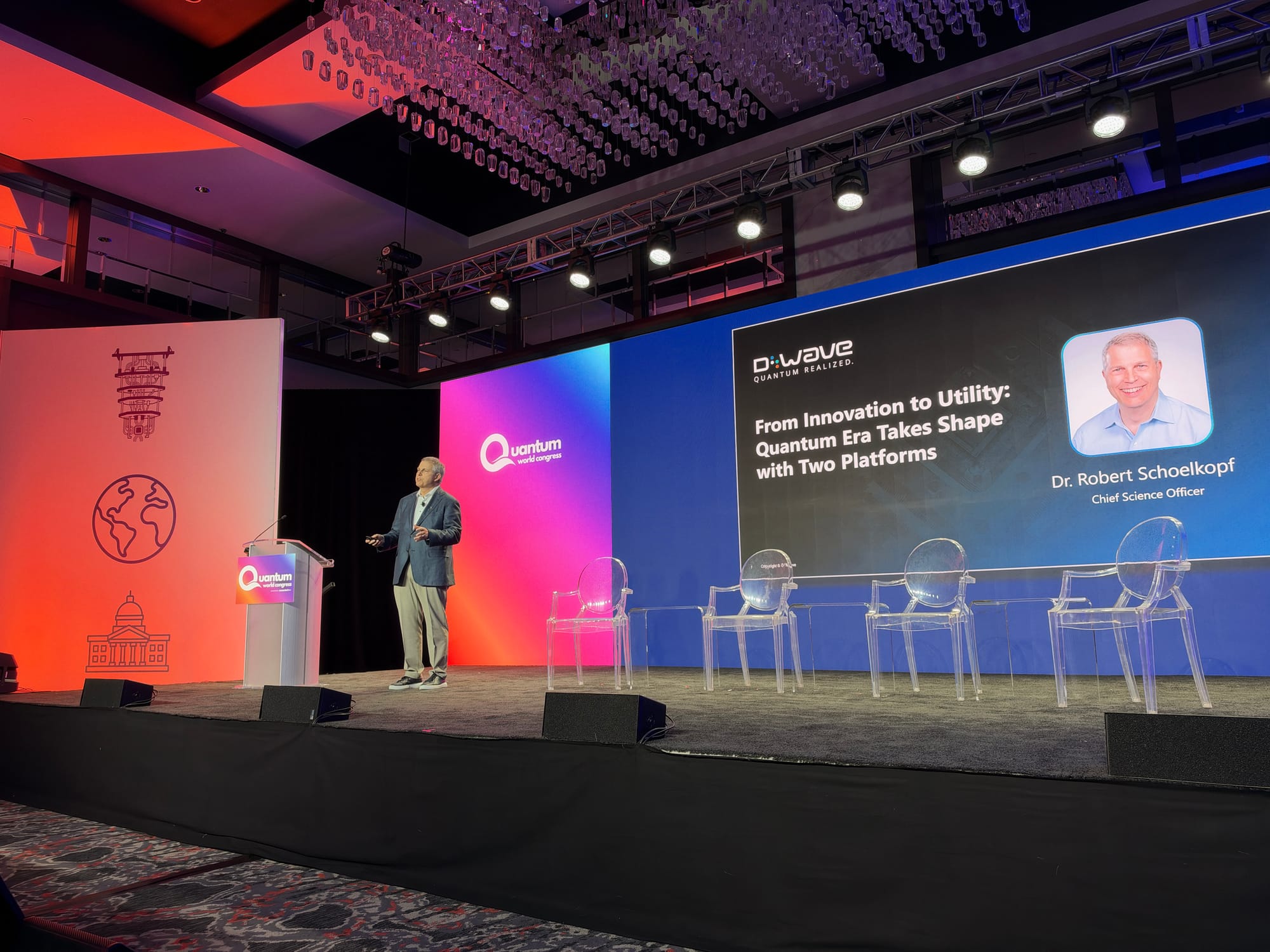
IonQ, headquartered in College Park, Maryland, has put Maryland on the map (along with the University of Maryland, where the technology originated) in the world of quantum computing. The state is investing heavily: Governor Wes Moore's "Capital of Quantum" initiative, announced in January 2025, aims for $1 billion in investment over five years, and the University of Maryland alone hosts several quantum research centers, a national quantum user facility run with IonQ, and startup programs including the Quantum Startup Foundry and the aforementioned Q-Cat.
At Quantum World Congress it was fascinating to observe 72 booths of vendors all along the spectrum: from superconducting and other quantum computing approaches (D-Wave, Microsoft, IBM, Quantinuum), and national efforts (Japan, Australia, Finland and Korea had their own booths, in addition to the US's FBI and individual states), to foundries for manufacturing (such as Anderon) and quantum networking (EPB Quantum as one example), to software for algorithm development (Classiq) and for error suppression (Q-CTRL).
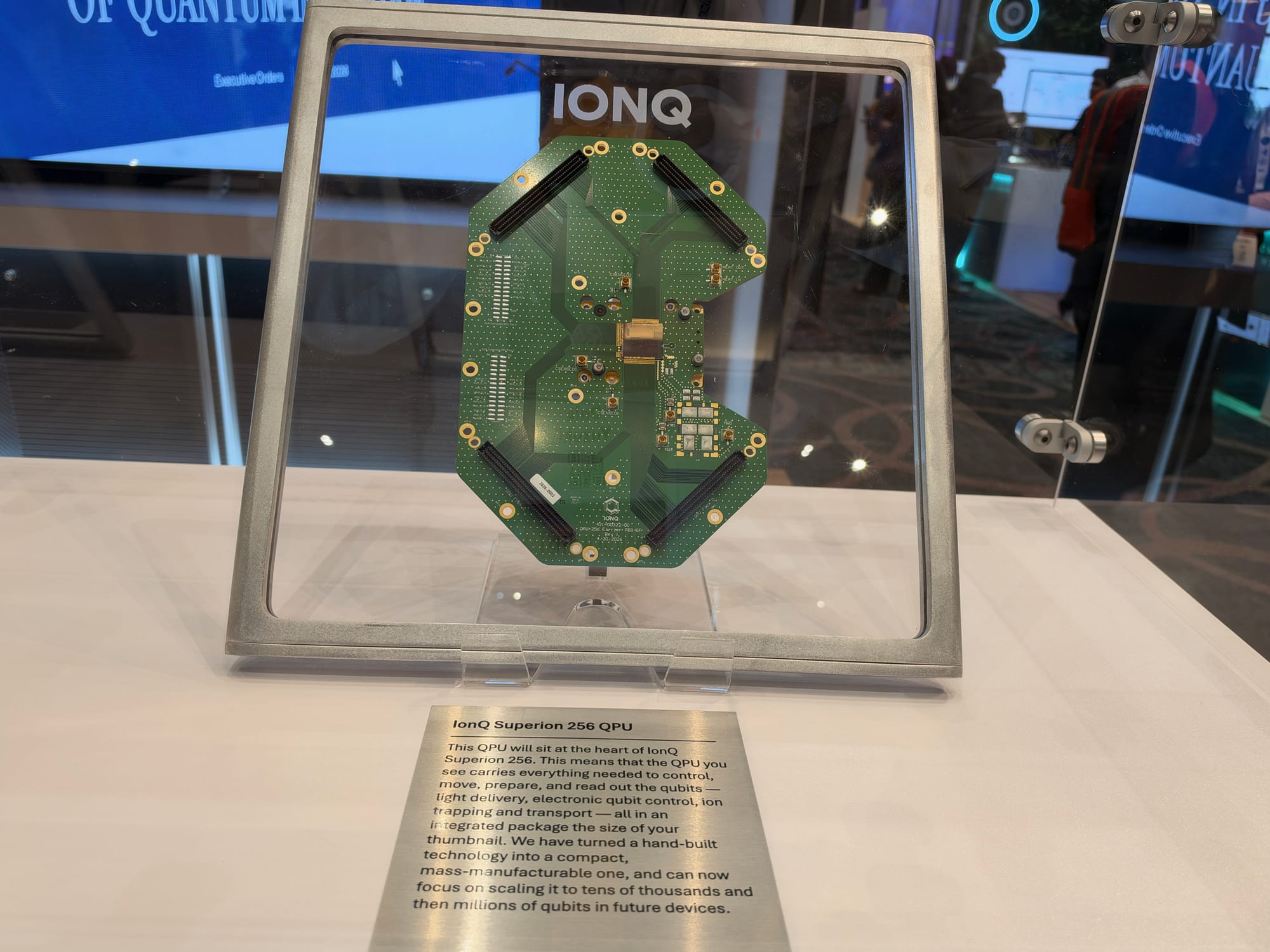
In this context there were presentations by Dr. Losert representing quantum sensors from his interdisciplinary, academic research perspective, and Dr. Markham of Element Six, giving his commercial take. It is notable that there were no exhibitors of NV diamond quantum sensors, although other kinds of quantum sensing were represented (Infleqtion, IonQ and Q-CTRL among them), and there were other panel discussions around other sensing modes for military and industrial applications that can be simplified across three broad problems to solve: position and time without the presence of GPS (next-generation atomic clocks and quantum navigation), seeing what is hidden (gravimeters or magnetometers or NV quantum sensors), or picking up signals (Rydberg-atom receivers and single-photon detectors).
Walking into the Element Six session early, I caught the tail end of an investor panel, and when it ended the entire group of investors left. Having a few minutes, sitting in the front corner, it was my pleasure to meet Dr. Markham sitting next to me. He then opened up a small plastic case, and showed me something really interesting. I’ll talk about that next.